At a glance
- Compare actual fibreUse declared dietary fibre per directed serving, not total powder weight.
- Check the whole formulaNamed fibres, culture information and suitability belong alongside the headline.
- Calculate like for likeCost per serving and cost per gram answer different purchasing questions.
Choosing the best fibre supplement for you starts with what you want to compare: fibre contribution, ingredients, preparation, preferences and suitability. There is no useful universal ranking based only on the size of a tub, the number of fibre ingredients or a headline probiotic count.
This guide gives you a practical way to read Australian product information. We developed and sell NuSync+, so we use it as a clearly identified worked example. The same comparison questions can be used when inspecting another formula.
1. Find declared dietary fibre per serving
Read the serving size and the dietary-fibre line together. A scoop or sachet tells you how much powder is used; it does not automatically tell you how much dietary fibre it contains. Keep nutrition-panel values separate from the weights of named ingredients.
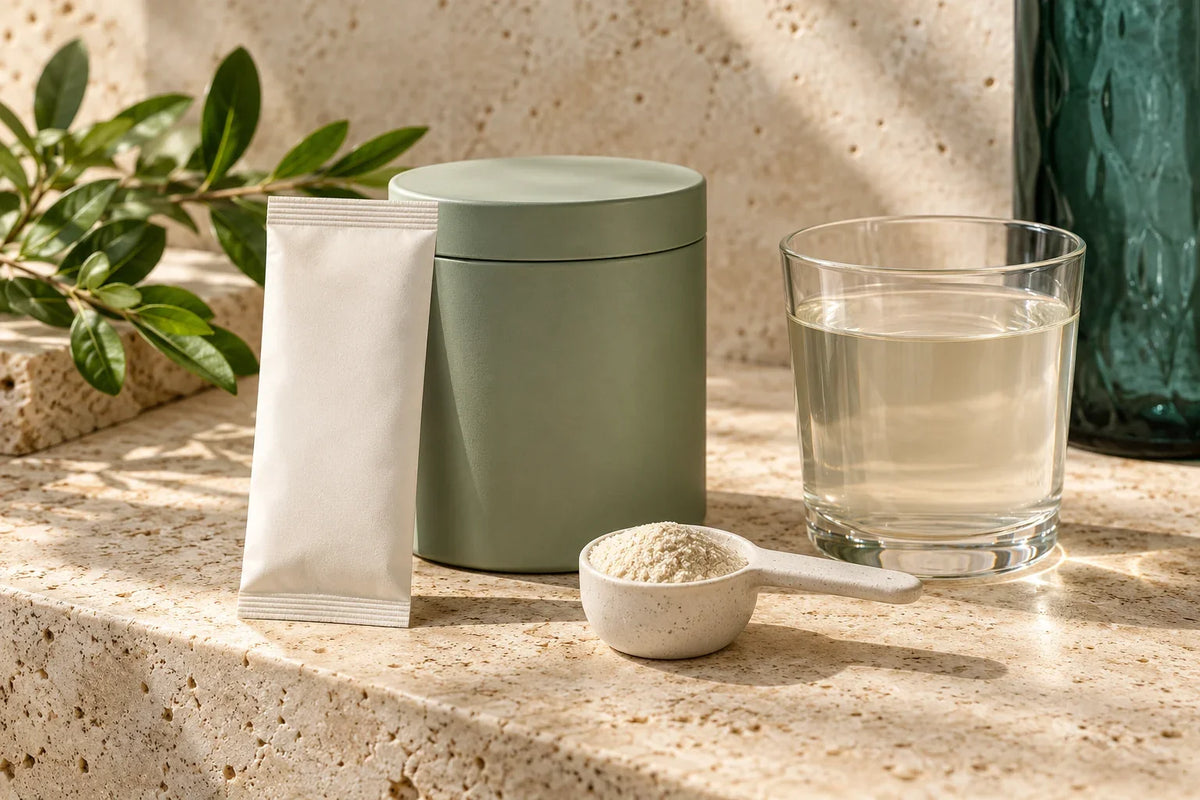
NuSync+ illustrates the difference: a 10 g sachet declares 8 g dietary fibre, while its four fibre ingredients total 8.2 g by ingredient weight. Use 8 g when comparing the fibre contribution. The remaining product information explains what else is in the mix.
| Check | Record for each product | Why it helps |
|---|---|---|
| Directed serving | Powder amount, scoop or sachet, and any daily directions. | Makes the comparison match the actual preparation. |
| Dietary fibre | Declared grams per serving. | Separates fibre from total powder weight. |
| Named fibres | The actual ingredients and amounts where disclosed. | Distinguishes a single ingredient from a blend. |
| Live cultures, if included | Culture identity, CFU, storage and the basis for claims. | Keeps fibre contribution separate from probiotic information. |
| Other ingredients | Flavouring, sweeteners and other components. | Helps assess preferences and dietary requirements. |
| Preparation | Water amount, mixing method and when to consume. | Shows the practical commitment of using the product. |
| Suitability | Allergens, age information, warnings and individual advice. | Checks whether the product is appropriate for your circumstances. |
| Value | Pack price, number of directed servings and delivery cost. | Avoids comparing tubs by weight or offers on different terms. |
2. Distinguish a single fibre, a blend and a combined formula
A single-fibre product, a blend of fibres and a mix that also contains probiotics are different offers. More ingredients do not, on their own, prove a better result. Read each formula on its own declared amounts, directions and evidence.
Names matter. PHGG means partially hydrolysed guar gum; it should not be treated as identical to every product called guar gum. NuSync+ contains PHGG alongside resistant dextrin, gum acacia and chicory-root inulin. It is a blend, rather than pure PHGG.
For a prebiotic description, ask what evidence supports the specific ingredient and serving. A substance being a fibre or being fermentable is not enough, by itself, to establish every prebiotic claim. [1] Our fibre, prebiotic and probiotic definitions guide explains the distinctions.
3. Read probiotic details as a separate comparison
If a product contains live cultures, record the culture identity, CFU, storage directions and whether the stated count relates to manufacture or the end of shelf life. Higher CFU alone is not proof of greater effectiveness. [2]
For a specific health claim, check whether the supporting research concerns the same microorganism, amount and use. A study of another strain or of one isolated ingredient cannot automatically become evidence for a different finished mix.
NuSync+ declares 2 billion CFU of Bacillus coagulans alongside 8 g dietary fibre per sachet. Read the culture information and fibre contribution separately when comparing formulas.
4. Choose a format you can prepare correctly
| Format | Practical feature | Check before choosing |
|---|---|---|
| Portioned powder sachets | A defined portion to carry or prepare. | The directed water amount, pack count and storage conditions. |
| Powder tubs | A multi-serving pack with a scoop or weighed portion. | How the directed serving is measured and how the open pack is stored. |
| Capsules or gummies | A different way to take a product. | Whether dietary fibre is declared, how many units make a serving and other ingredients. |
A convenient format is one you can use as directed. Do not assume a capsule or gummy supplies the same fibre amount as a powder serving. Equally, a scoop from one tub cannot be substituted for another product's serving measure.
NuSync+ uses a 10 g sachet with 410 mL cold water. A different powder's dilution is not a substitute. Review the full preparation method rather than choosing only by the number of servings printed on the pack.
5. Check flavour, storage and suitability
Read the ingredient list as well as the flavour name. A sweet taste can come from ingredients other than sugar. Check the named sweeteners, allergens and any dietary information that matters to you; a rounded nutrition value is not a complete description of the formula.
NuSync+ is Yuzu Lemon flavoured and includes steviol glycosides. Its label directs cool, dry storage away from heat and direct sunlight. These are specific product facts, not assumptions to apply to every fibre powder or culture.
If you are choosing a product because of persistent symptoms, a diagnosed condition, medicines or a prescribed diet, seek individual advice. An article can help you compare information; suitability still needs to be assessed for your circumstances.
6. Compare cost per directed serving and gram of fibre
Divide the purchase price by its number of directed servings. To compare the cost of its declared fibre contribution, divide that serving cost by the declared grams of dietary fibre. Keep both calculations visible: they answer different questions.
NuSync+ Single price checked on 8 October 2026
A$50 ÷ 20 sachets = A$2.50 per serving
A$2.50 ÷ 8 g declared dietary fibre = A$0.3125 per gram, approximately A$0.31.
The example uses the regular Single price, before delivery or any order discount. Check current prices and offer conditions. Sale, member and subscription prices need to be identified separately when comparing purchases.
Cost per gram of fibre does not measure probiotic value or health benefit. A combined formula and a plain fibre ingredient are not identical purchases, even when a calculation uses the same unit.
Make a shortlist from clear information
- Record each product's directed serving and declared dietary fibre.
- Note the named fibres and any separately stated culture information.
- Check preparation, preferences, storage and suitability.
- Compare current pack commitment and cost per serving on the same basis.
- Identify any claim or missing detail you would need clarified before choosing.
For the daily dietary context, read how much fibre adults need each day. To browse our offered formats, explore the fibre and probiotics range. For the exact ingredients, nutrition and directions behind our example, see the complete NuSync+ product information.
Sources and approach
- Hutkins and Scott for ISAPP — Criteria for prebiotics (2024; updated 2025)
- US National Institutes of Health, Office of Dietary Supplements — Probiotics
Sources checked on 8 October 2026. Prepared by Coreffect Health using the sources linked above and our product labels. This is general educational information; ingredient research is distinguished from evidence for our finished products. See our editorial approach and health information disclaimer.