
Some trials of oral collagen report improvements in measured skin hydration or elasticity. The evidence is not a simple promise of younger-looking skin: reviews differ in their assessment, and results for one measurement do not establish benefits for every outcome or every product.
The useful question is not only “does collagen work?” It is what was tested, what changed, and how confidently can the finding be applied?
At a glance
- Read the actual outcomeHydration, elasticity and wrinkles are different measures—not interchangeable benefits.
- Read the limitationsTrial quality, funding, variation and short follow-up affect confidence.
- Check the formula matchGeneral ingredient research is not clinical testing of finished Velora+.
What do collagen research reviews report?
Systematic reviews gather studies using stated eligibility criteria. A meta-analysis then combines compatible results statistically. That can reveal a pattern, but it cannot remove limitations in the underlying studies simply by pooling them.
| Review and trial pool | What it reported | What limits the interpretation |
|---|---|---|
| Pu et al., 2023 26 randomised controlled trials; 1,721 participants |
Pooled findings favoured hydrolysed collagen for measured hydration and elasticity. [1] | The authors identified biases and called for larger trials. The findings do not establish a universal visible result. |
| Myung & Park, 2025 23 randomised controlled trials; 1,474 participants |
Overall pooled findings favoured collagen for hydration, elasticity and wrinkles. [2] | Effects were not significant in high-quality and non-pharmaceutical-company-funded subgroups. The authors found no clinical basis for preventing or treating skin ageing. |
| Batool et al., 2026 35 randomised controlled trials; 2,534 participants |
The updated analysis reported improvements in measured hydration, elasticity and barrier function. [3] | Structural findings, including wrinkles and density, were not robust after sensitivity checks. Formulation differences, publication bias concerns and short follow-up remained important. |
These are overlapping research pools, not three independent groups whose participant counts should be added together. A more favourable updated review does not erase quality concerns, and a critical review does not prove that every possible formulation is ineffective.
Hydration is not the same outcome as fewer wrinkles
Skin hydration concerns water content. Elasticity measurements assess aspects of the skin’s mechanical response. Wrinkle measures, roughness, skin density and a participant’s own perception are separate endpoints.
When an advert says “clinically proven skin benefits”, ask which of those outcomes was actually measured. An instrument detecting a change is not automatically evidence that a person will notice a meaningful visible transformation.
Likewise, “statistically significant” means a result met a statistical criterion in that analysis. It does not mean the effect is large, certain for every individual, or relevant to every product with collagen on its label.
Why can reviews reach different conclusions?
Reviewers may search at different dates, select different trials, include different preparations or assess bias differently. They can also use different approaches to handling multiple measurements and influential studies.
A sensitivity analysis asks whether a finding remains when an influential study is removed or an analytical choice changes. If a headline result depends strongly on one study, that is relevant to confidence—not a detail to omit from a product claim.
Funding is another relevant question. A funded study is not automatically invalid, but independence, methods, reporting and the pattern across higher-quality trials should all be visible. The 2025 review’s subgroup findings are one reason a simple pooled “yes” is incomplete. [2]
How much collagen—and how long—did studies test?
The 2026 review describes a wide range of preparations and amounts, with reported daily doses spanning approximately 0.5–10 g and study periods generally measured in weeks. Participants were predominantly women, and formulations and outcome measurements varied. [3]
Those study conditions are context, not a universal recommended dose or a guaranteed result date. A higher amount does not automatically mean a larger benefit, and a finding for one studied ingredient cannot be transferred by matching grams alone.
For a specific product, follow its actual directions. A 28-serving pack is a pack size, not evidence that visible changes will occur by day 28. Nor does the literature justify a Velora-specific morning-versus-evening benefit or an instruction to take more than its directed serving.
Five questions to ask about a skin claim
- Who took part? Check the participants, sample size and whether the population matches the claim.
- What was tested? Identify the ingredient or finished formula, amount, duration and comparison group.
- What changed? Look for the exact endpoint and the difference from the control group, not only a before-and-after description.
- How reliable was it? Consider trial methods, funding, missing results, consistency and sensitivity checks.
- Does it match this product? Separate ingredient-level findings from clinical testing of the finished formulation being sold.
A testimonial or an attractive portrait cannot answer those questions. The portrait accompanying this guide is an illustration, not a customer, a study participant or a product-result image.
Where does Velora+ fit?
Coreffect Health researched, developed and sells Velora+, so we have a commercial interest in collagen. We make its composition clear without presenting the research above as a clinical trial of our finished drink mix.
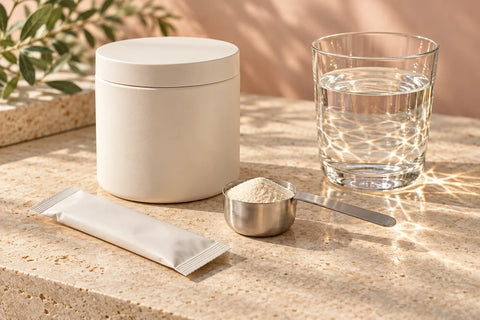
Each 10 g sachet declares 6 g total marine collagen: 5,500 mg marine collagen peptides plus 500 mg marine collagen tripeptides. It also declares 120 mg sodium hyaluronate and 40 mg vitamin C. Those are label facts, not evidence of a particular skin outcome.
Velora+ contains fish and is not vegan or vegetarian. Its directions are one sachet in 600 mL cold water, once daily. Read the full product ingredients and directions for suitability information. This article is general education, not an assessment or treatment plan for a skin condition.
Make the next comparison a clear one
For terminology, read marine and bovine collagen, peptides and tripeptides explained. For format, serving amounts and value, continue to how to choose collagen powder in Australia.
The marine collagen category provides the offer overview. Keep the same distinction wherever you read about collagen: a formula declaration explains what is in a product; a relevant study is needed to substantiate a clinical claim.
Sources and approach
- Pu et al. (2023) — Effects of oral collagen for skin anti-aging: systematic review and meta-analysis. Published 26 April 2023, Nutrients 15(9):2080.
- Myung & Park (2025) — Effects of collagen supplements on skin aging: systematic review and meta-analysis. The American Journal of Medicine 138(9):1264–1277.
- Batool et al. (2026) — Oral collagen peptides and skin rejuvenation: updated systematic review and meta-analysis. Journal of Cosmetic Dermatology 25(7):e71041.
Sources checked on 9 October 2026. Prepared by Coreffect Health. This guide concerns oral collagen and skin research, not every possible use of collagen. It does not claim medical-review credentials or clinical testing of our finished product. See our editorial approach and health information disclaimer.