The best collagen powder for your needs starts with a readable label, a suitable format and a fair comparison. Look at the actual collagen amount per directed serving—not just scoop size, pack weight or the most technical ingredient name.
This is a guide from Coreffect Health, which developed and sells Velora+. We use our product as a worked example and do not present this as an independent product ranking.
At a glance
- Compare like with likeRead source, collagen amount and the rest of the formula for each product.
- Use labelled servingsPack price divided by serving count is more useful than price per scoop.
- Separate facts from promisesA clear formula and good value do not, by themselves, establish a clinical result.
A practical collagen comparison checklist
| Check | What to look for | Why it matters |
|---|---|---|
| Source | Marine, bovine or another clearly identified source. | Source and ingredient form are different details. |
| Declared collagen | Grams of collagen per directed serving. | A 10 g scoop or sachet does not necessarily contain 10 g collagen. |
| Ingredient form | Peptides, tripeptides and what any component amount refers to. | A technical term is not an automatic quality ranking. |
| Whole formula | Full ingredients, flavour, sweeteners and other declared amounts. | A plain ingredient and a flavoured drink mix are different purchases. |
| Suitability | Allergen statement, dietary requirements and actual origin information. | Brand location alone does not establish where a product is made. |
| Preparation | Directed serving, water quantity and frequency. | The product should fit the way you intend to prepare it. |
| Value | Labelled servings, total price and delivery or offer conditions. | Compare the same purchase basis rather than headline prices alone. |
| Evidence | Which ingredient or finished formula was studied, and for what outcome. | Composition information and clinical evidence answer different questions. |
Start with source and ingredient form
Marine and bovine describe origin. Collagen peptides describe a processed ingredient form; marine collagen can also be collagen peptides. Source and processing both belong in an ingredient description. [1]
If a brand claims a particular molecular size, faster absorption or a superior result, check the evidence for that exact claim. Do not infer it from the word marine or tripeptide. Our source, peptide and tripeptide guide explains the terminology in more detail.
Separate powder weight from collagen amount
The front of a pack may show total net weight; the directions may show a scoop or sachet weight. Neither is necessarily the collagen amount. Look for a declaration per serving and check how any blend components add up.
| Detail | Declared amount | How to compare it |
|---|---|---|
| Finished powder | 10 g sachet | The complete drink mix. |
| Marine collagen blend | 6 g total | The collagen amount within that sachet. |
| Marine collagen peptides | 5,500 mg | Part of the 6 g blend. |
| Marine collagen tripeptides | 500 mg | Also part of the 6 g blend, not additional to it. |
| Sodium hyaluronate | 120 mg | The named ingredient, kept separate from collagen. |
| Vitamin C | 40 mg | A separately declared nutrient amount. |
These declarations make comparison possible. They are not proof that a higher collagen quantity or a longer ingredient list produces a better outcome. Keep sodium hyaluronate’s identity intact, and do not reinterpret a tripeptide ingredient weight as an unverified amount of one isolated peptide.
Sachets, tubs and other formats
| Format | Practical check |
|---|---|
| Portioned powder sachets | Serving size is pre-measured. Check water volume and the number of sachets in the pack. |
| Powder tub | Check the directed powder weight, how to measure it and the labelled serving count. |
| Capsules or gummies | Read the collagen amount for the full directed serving—not just one capsule or gummy. |
| Ready-to-drink products | Check the amount per bottle or directed portion and whether other ingredients change the comparison. |
Formats solve different preparation tasks. Portability, measuring, flavour and the amount of water can matter to your routine without making one format intrinsically more effective.
Velora+ is a Blood Orange Peach drink mix: one 10 g sachet in 600 mL cold water, once daily. Its Single pack contains 28 sachets. Consider that preparation volume as part of choosing the product, rather than assuming every powder is mixed the same way.
Calculate cost per serving fairly
Use the actual purchase price and the pack’s directed serving count:
- Cost per serving = pack price ÷ labelled servings.
- Cost per gram of declared collagen = pack price ÷ (labelled servings × collagen grams per serving).
At the checked A$73.00 Velora+ Single price, 28 servings work out to approximately A$2.61 per serving. Each contains a declared 6 g collagen blend, so the same pack works out to approximately A$0.43 per gram of declared collagen. The calculations use unrounded values before rounding the displayed result.
Price checked on 9 October 2026. Delivery is separate. Duo and Trio provide two or three regular packs together, with 56 or 84 sachets; use their current displayed purchase price if comparing those offers. Promotions, subscriptions and delivery charges should be kept on the same basis across brands.
Cost per gram is a quantity comparison, not a clinical-effectiveness score. It also does not capture flavour, added ingredients, format or suitability. Use it alongside the label, not instead of it.
Read ingredients, allergens and origin
Compare the complete formula, including flavour ingredients and sweeteners. “Flavoured” does not tell you which sweeteners are used, and “no added sugar” is not the same description as unsweetened. Check what the actual label says rather than assuming from an image or product name.
Velora+ contains fish and is not vegan or vegetarian. Coreffect Health is Australian-owned. Australian ownership and Australian manufacture are distinct facts, and should stay distinct when comparing products.
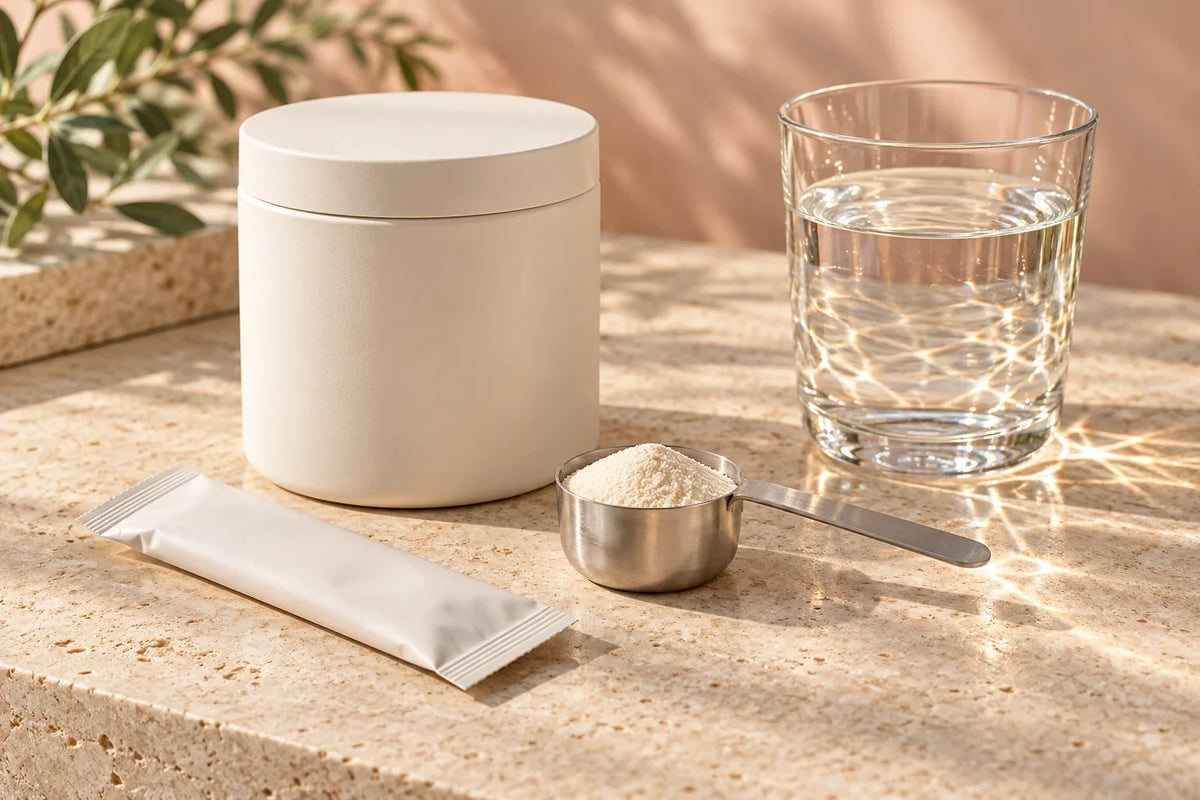
Read Velora’s full ingredients, nutrition and directions for the product-specific detail. The anonymous packaging in this guide’s illustration shows formats; it is not an image of the actual Velora pack.
Read the evidence before the promise
Reviews of oral collagen and skin do not all reach the same assessment. Study quality, funding, tested formulations and measured outcomes affect how confidently findings can be interpreted. [2] [3]
Ask whether a claim concerns the same ingredient, dose and finished formula. A study on another formulation is not automatically a trial of the product in your basket. We do not describe finished Velora+ as clinically tested on the basis of general collagen ingredient studies.
Continue to what the skin research can—and cannot—tell you, or explore our marine collagen offer with these comparison checks in mind.
Sources and approach
- León-López et al. (2019) — Hydrolyzed collagen: sources and applications — source and processing context.
- Myung & Park (2025) — Effects of collagen supplements on skin aging: systematic review and meta-analysis.
- Batool et al. (2026) — Oral collagen peptides and skin rejuvenation: updated systematic review and meta-analysis.
Sources and the Single price checked on 9 October 2026. Prepared by Coreffect Health using the sources linked above and our declared product information. We sell Velora+ and make that commercial interest explicit. This is general education, not personalised health advice or an independent ranking. See our editorial approach and health information disclaimer.